Key Takeaways
- Content velocity stalls upstream of writers, where unprioritized intake, half-built briefs, and unrouted reviews create coordination drag that adding drafting capacity cannot fix.
- Treat the brief as a governed artifact scored on audience specificity, evidence requirements, SEO constraints, and voice—briefs below threshold return to the strategist, not the writer.
- Layer NIST's Govern-Map-Measure-Manage and the PPTO accountability model over the five operational stages, and replace vague RACI with a decision-rights matrix naming one owner and SLA per stage.
- Instrument brief-to-draft latency, review queue depth, rewrite rate, and post-publish performance per layer so the Content Marketing Manager fixes the real bottleneck instead of the loudest one 5.
Why content velocity stalls before it reaches the writer
Most content teams diagnose their throughput problem at the wrong layer. When publishing slips, the reflexive answer is to add writers, extend deadlines, or buy more drafting tools. The actual constraint usually sits upstream: requests arrive without prioritization, briefs land on writer desks half-built, and approvals stack in queues no one is paid to clear. By the time a draft exists, the work has already lost two weeks to coordination drag.
The U.S. Department of Labor's content governance guidance puts the diagnosis plainly—mapping the workflow itself is what helps teams identify and proactively mitigate potential bottlenecks before they calcify into missed cycles 8. Teams shipping 50 or more pieces per quarter rarely have a writing problem. They have an intake problem, a brief problem, and a review-routing problem stitched together.
This shifts the operating question for a Content Marketing Manager. The job is no longer commissioning more drafts. It is engineering a pipeline where intake, brief construction, drafting, review, and publishing function as one governed system. The sections that follow break that pipeline into its five operational layers, then layer governance and metrics on top so the bottleneck stops moving every quarter.
The five operational layers of a ContentOps pipeline
Intake: turning requests into prioritized briefs
Intake is where most editorial calendars quietly fail. Requests arrive through Slack DMs, product launch tickets, SEO spreadsheets, and the occasional executive forward, and they all carry the same implicit priority: now. Without a single intake surface, the Content Marketing Manager becomes the routing layer, which is the most expensive way to triage work.
A functioning intake layer enforces three things before anything enters the calendar:
- A standard request form that captures audience, business outcome, source of demand (keyword cluster, product release, sales enablement gap), and the evidence the requester already has.
- A prioritization rubric that scores each request on pipeline impact, search demand, and strategic fit, so the calendar reflects portfolio decisions rather than the volume of the loudest internal voice.
- A published intake cadence—weekly grooming, biweekly commit—so requesters know when their item gets scored and when it earns a slot.
For healthcare operators, intake is also where patient-needs alignment enters the pipeline. Marketing strategy research links measurable outcomes to disciplined identification of patient needs and latent demand 2. Encoding that discipline at intake prevents the calendar from drifting into internal-stakeholder content nobody outside the building searches for.
Brief construction as the real production constraint
Once an item clears intake, the brief is where throughput is won or lost. Briefs that arrive on a writer's desk with vague audience definitions, no evidence shortlist, and a single SEO keyword stapled to the top will generate drafts that need two or three rewrite cycles. Each rewrite cycle re-enters the review queue, compounding latency. The cheapest place to fix a draft is before it exists.
The U.S. Department of Labor's content governance guidance is explicit on this point: mapping the workflow helps teams identify and proactively mitigate potential bottlenecks before they harden into chronic delays 8. Applied to briefs, that means treating the brief itself as a governed artifact with a quality scorecard, not a free-text document.
Four dimensions belong on that scorecard:
- Audience specificity—named role, named scenario, named decision the reader is trying to make, not a generic persona.
- Evidence requirements—the specific studies, internal data, customer quotes, or product proofs the draft must cite, sourced and linked at brief time.
- SEO constraints—primary cluster, secondary entities, search intent classification, and the competing URLs the draft must outperform.
- Brand voice constraints—tone register, sentence rhythm guidance, banned phrases, and the one or two stylistic moves that define the publication.
Briefs that score above a defined threshold on all four dimensions enter the drafting queue. Briefs that fall short return to the strategist, not the writer. This single routing rule changes the economics of the pipeline: writers stop absorbing the cost of unclear thinking upstream, SME reviewers stop seeing drafts that were never going to pass on the first pass, and the calendar stops absorbing rewrite cycles disguised as edits.
Drafting: where AI assistance earns its place in the pipeline
Drafting is the layer where AI tools have done the most visible work and the most invisible damage. A model can produce a 1,500-word draft from a thin brief in under a minute, which feels like progress until the draft enters review and triggers the same rewrite cycles a junior writer would have caused, only at higher volume. Speed at the drafting layer without governance upstream pushes the bottleneck downstream rather than removing it.
AI drafting earns its place when it operates inside a brief that already meets the four-dimension scorecard and inside a generation pattern the team has tuned. That means structured prompts that pass the brief, evidence shortlist, voice constraints, and target outline as inputs—not a one-shot instruction to write an article. It also means treating the first AI output as a structured zero draft, with named sections, claim placeholders that point to specific references, and explicit gaps marked for SME input. The writer or content strategist then becomes an editor and evidence-checker rather than a blank-page author.
The practical result is that drafting time compresses while the quality entering review goes up. The decisive variable is not which model is used. It is whether the inputs to the model are governed at brief stage and whether the outputs route through a defined human checkpoint before they hit the reviewer queue.
Review routing and queue depth
Review is where most ContentOps pipelines actually break. A draft that took two hours to produce can sit five business days waiting on an SME, three more on legal or compliance, and another two for channel owner sign-off. Cycle time in those teams is not a drafting problem—it is a queue depth problem, and adding writers makes it worse.
NIH research on workflow automation in healthcare makes the underlying point directly: poorly integrated automation can increase workload or introduce new safety risks rather than reduce them, because the automation accelerates one step while leaving downstream steps untouched 5. The same dynamic applies to content. A team that adds AI drafting without restructuring review routing will watch its review queue grow, not shrink.
In an operator-observed pattern across mid-volume content teams, time inside a single content cycle distributes roughly as follows:
- Brief construction absorbs around 15% of cycle time
- Drafting 20%
- SME review 30%
- Legal or compliance review 20%
- Publishing the remaining 15%
Review—SME plus legal—consumes half the cycle. That is the layer to instrument.
Three routing rules cut queue depth without adding reviewers:
- Parallelize SME and legal review for content that does not require sequential dependency.
- Define a service-level expectation per reviewer role (for example, 48 hours for SME, 72 hours for legal) and publish queue status weekly so escalation is visible.
- Route drafts to the smallest reviewer set the content risk justifies—not every blog post needs three approvers.
Publishing, distribution, and feedback capture
Publishing is more than pressing publish. It is the layer that closes the loop between what the workflow produced and what the workflow should produce next. Teams that treat publishing as the end of the pipeline lose the data that would improve every layer above it.
Three operational habits separate a publishing layer that scales from one that stalls:
- Structured metadata at publish time—canonical cluster, primary keyword, internal link targets, and the reviewer chain of custody—captured in the CMS rather than a separate spreadsheet.
- Distribution routing tied to the asset's job: sales enablement assets push to enablement libraries, demand-gen assets enter nurture sequences, SEO assets queue for internal linking sweeps.
- A feedback capture window—30, 60, and 90 days post-publish—that pulls ranking, engagement, and pipeline signal back into the intake rubric so future requests get scored on evidence rather than instinct.
Done well, publishing becomes the layer that retrains the rest of the pipeline rather than the layer where work disappears from the team's attention.
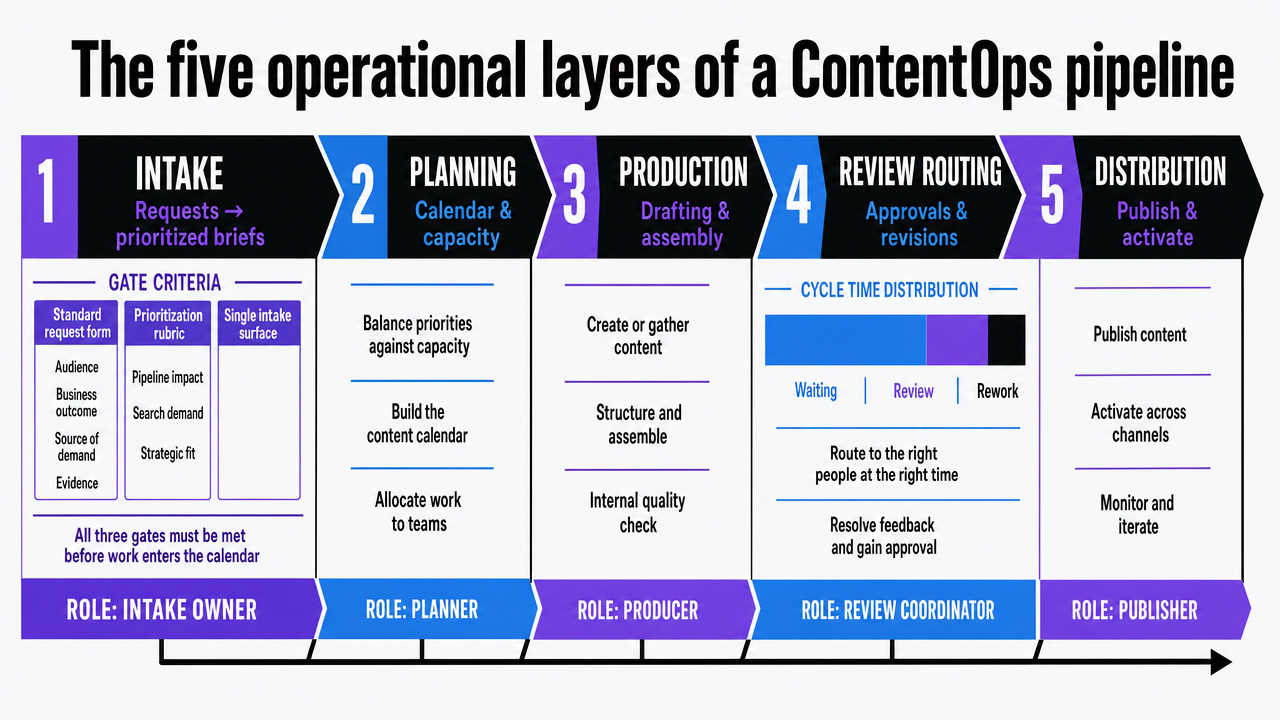 Visualize the five sequential layers of the ContentOps pipeline described in the section, showing each stage's role and the approximate cycle-time distribution mentioned in the review routing subsection
Governance scaffolding: adapting NIST and PPTO for content teams
Govern, Map, Measure, Manage applied to editorial operations
The NIST AI Risk Management Framework was written for AI systems, but its four functions—Govern, Map, Measure, Manage—translate cleanly to editorial operations once a team has AI in the drafting layer 3. Each function answers a question the content calendar cannot answer on its own.
Govern : Asks who owns the policy stack: which content categories require legal review, which AI uses are sanctioned, which evidence standards apply per content type, and how exceptions get logged. Without a named owner, governance defaults to whoever happens to flag a problem, which is the same dynamic that produces inconsistent disclosures and surprise compliance escalations.
Map : Asks what the workflow actually contains. That means an inventory of content categories (clinical education, sales enablement, demand-gen, location pages), the AI touchpoints inside each one, and the human checkpoints that gate them. A team that cannot draw its own map cannot defend it.
Measure : Assigns the instrumentation: cycle time by layer, rewrite-rate per reviewer, evidence-citation accuracy, and post-publish performance against the brief's stated outcome.
Manage : Closes the loop—monthly review of where the numbers drifted, who owns the corrective action, and which workflow rule changes as a result.
The four functions sit above the five operational layers as a control plane, not a parallel process.
People-Process-Technology-Operations for AI-assisted content
Where NIST supplies the control plane, the People-Process-Technology-Operations (PPTO) model from healthcare AI governance supplies the accountability map. The NIH research that introduced PPTO in a hospital-system context argues that effective AI governance must embed accountability across people, processes, technology, and operations, with continuous monitoring and clearly defined escalation pathways 6. The same four columns hold up an AI-assisted content workflow.
People : Names the roles, not the headcount: Content Strategist owns brief quality, SME reviewer owns factual accuracy, legal counsel owns regulatory exposure, channel owner owns distribution fit, and an AI governance lead—often the Content Marketing Manager wearing a second hat—owns model selection, prompt libraries, and disclosure standards. Each role has a named backup so reviews do not stall on vacation calendars.
Process : Names the artifacts that cross those roles: the brief scorecard, the structured zero draft, the review checklist per content category, the disclosure template, and the publish-time metadata schema. Each artifact has a version and an owner.
Technology : Names the stack with its governance attached: which models are sanctioned for which tasks, where prompt libraries live, which CMS fields capture the reviewer chain of custody, and which monitoring tool watches for drift in tone, accuracy, or performance.
Operations : The layer most teams skip. It is the standing cadence—weekly queue review, monthly accuracy audit, quarterly policy refresh—that keeps the other three columns honest.
The supplementary materials accompanying the PPTO research show example process diagrams where AI outputs route through defined human review checkpoints, reinforcing that governance is a continuous operational discipline rather than a one-time policy 7.
A decision-rights matrix that replaces vague RACI
RACI charts fail in editorial operations for a predictable reason: every reviewer marks themselves as Accountable, every contributor marks themselves as Consulted, and the document becomes wallpaper. A decision-rights matrix replaces the four-letter ritual with a question per lifecycle stage: who decides, by when, and on what evidence.
The matrix has five columns:
- The lifecycle stage (intake scoring, brief approval, draft acceptance, SME sign-off, legal clearance, publish, post-publish optimization).
- The decision being made at that stage, phrased as a yes/no or a routing call.
- The single named role that owns the call—one name, not a committee.
- The service-level expectation, in business hours or days, that the decision must clear.
- The escalation path if the SLA breaks, including who absorbs the decision by default.
Two rules keep the matrix honest. A stage with two accountable owners is a stage with none, so the matrix forces a tiebreaker. And every SLA breach generates a logged exception, reviewed in the Operations cadence, so chronic breakage at one stage becomes a workflow change rather than a recurring complaint. The result is that the team stops debating who owns the decision and starts debating whether the decision was the right one.
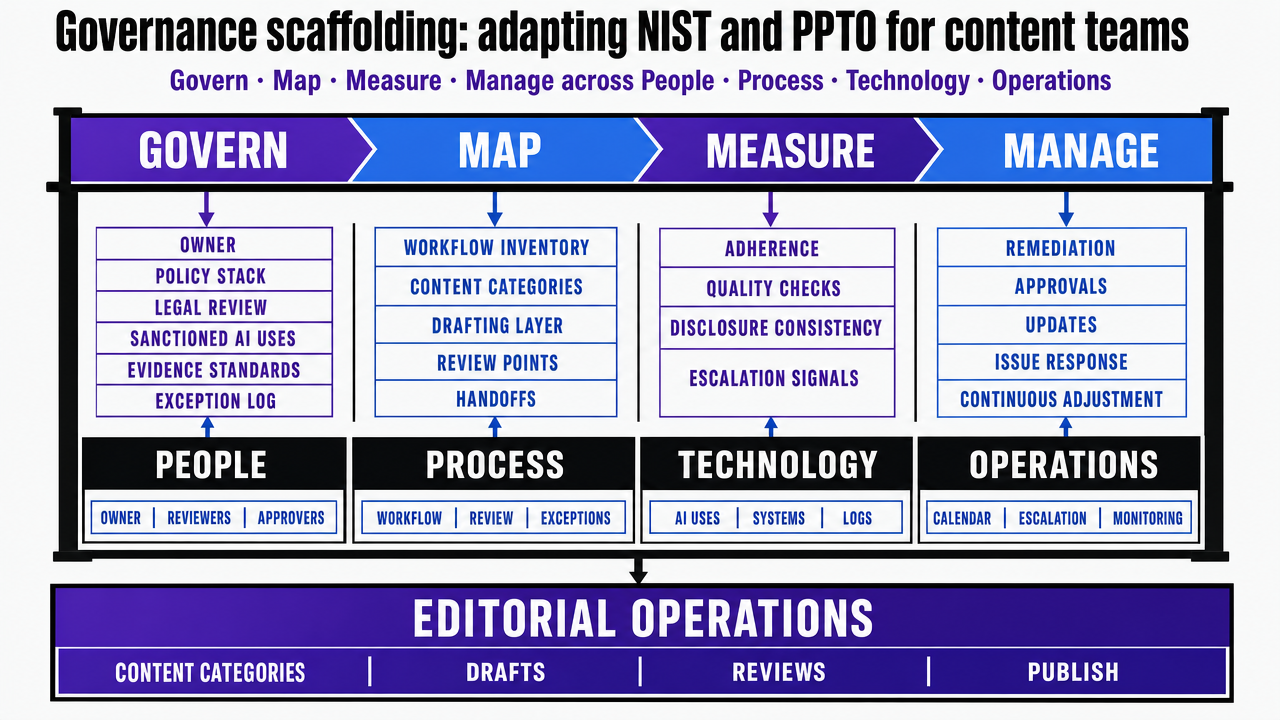 Show how the NIST Govern-Map-Measure-Manage functions and the PPTO (People-Process-Technology-Operations) accountability columns combine into a governance scaffold over editorial operations, as cited from refs 3, 6, and 7
Test a scalable creative workflow in production
Experience hands-on how automated content workflows accelerate publishing and eliminate production bottlenecks in real time.
Compliance, disclosure, and the trust layer
Review gates for clinical brands and regulated SaaS categories
Compliance review fails in editorial pipelines when it is treated as a single gate rather than a graded set of them. A location page promoting a cardiology service line, a blog post summarizing a recent clinical study, and a social post quoting a clinician each carry different exposure, and routing them through identical approval chains burns reviewer hours on the safest assets while underweighting the riskiest ones.
For clinical brands, the published social media behavior guidelines for healthcare professionals describe the standard plainly: digital communications under clinical authority require meticulous adherence to ethical, legal, and professional standards, including patient privacy and the dissemination of accurate information 1. That standard does not translate into one approval lane. It translates into tiered gates indexed to content category:
- Tier one—location pages, evergreen service descriptions, FAQ pages—routes through Content Strategist and channel owner.
- Tier two—condition education, treatment overviews, clinical study summaries—adds an SME reviewer with documented clinical credentials and a citation check against primary literature.
- Tier three—anything quoting a named clinician, referencing patient outcomes, or touching on regulated claims—adds legal counsel and a privacy review against the patient-data inventory.
Regulated SaaS categories (fintech, health-adjacent, security) follow the same tiering logic with different reviewers. The discipline is the same: the gate matches the risk, and the matrix names which gate every content category enters before it ever reaches a writer.
Provenance and AI disclosure as a workflow output
Disclosure is a workflow output, not a legal footnote. When AI participates in drafting, the pipeline has to decide what gets labeled, where the label appears, and which audit trail backs it up—decisions that belong in the brief scorecard and the publish-time metadata schema, not in a reviewer's last-minute judgment call.
The FDA's 2025 draft guidance on AI-enabled device software functions sets a useful directional standard for healthcare-adjacent communications. It recommends labeling that includes a statement that AI is used, model inputs and outputs, performance data, and known limitations, presented in a format and at a reading level appropriate for the intended user 9. The guidance applies to devices, not marketing copy, but the underlying expectation—that AI involvement is documented and accessible to the reader—is migrating into broader healthcare communications. Content teams that build the documentation now will not be rebuilding it under deadline later.
Provenance signals also affect how readers weigh the content. University of Washington Center for an Informed Public research on provenance and synthetic media found statistically significant effects on trust and accuracy perceptions when provenance information was shown to users, though the same study cautioned that disclosure can introduce misinterpretation if signals are ambiguous 10. The operational implication is concrete: define a single disclosure pattern (where AI was used, what a human verified, which sources the draft cites), apply it consistently, and capture the chain of custody in the CMS so the disclosure is auditable rather than performative.
If you manage multiple locations or a portfolio: centralizing content economics
This section narrows to a different operator: the Content Marketing Manager running a portfolio—10 healthcare locations, a SaaS company with three product lines, or an agency servicing both. The five-layer pipeline holds, but the economics of running it under a traditional retainer model collapse fast once the location count climbs.
The cost structure most multi-location operators inherit is built around per-location billing, parallel account managers, and serialized handoffs. The table below isolates the structural drivers rather than fabricating dollar figures—operators should plug in their own retainer rates and volume targets.
| Cost driver | Traditional agency retainer (10 locations) | Centralized AI-assisted ContentOps |
|---|---|---|
| Billing unit | Per-location monthly retainer × 10 | Account-level program covering all locations |
| Account management overhead | 1–2 account managers per book of business | Internal Content Marketing Manager owns intake |
| Brief construction | Repeated per location, often duplicated | Shared brief templates with location variables |
| Review routing | Sequential through agency PM, then client | Parallel SME and legal lanes inside one system |
| Handoff latency | Multi-day per location per cycle | Same-day within governed pipeline |
| Volume ceiling | Capped by writer roster and PM bandwidth | Capped by review queue depth, not drafting |
Two structural points sit underneath the table. First, per-location billing rewards duplication—each retainer renegotiates the same brief templates, voice guidelines, and SME relationships. Second, account-manager overhead is a latency tax: every cross-location decision routes through a coordination layer that adds days without adding judgment. Centralizing the workflow at the account level removes both, and the savings appear as faster cycle time, not just lower invoices.
Streamline Article Production with a Data-Driven Creative Workflow
See how leading agencies and enterprise teams automate content workflows—turning keyword research into publish-ready articles at scale, without bottlenecks or writer delays. Explore solutions proven to reduce cycle times and increase output consistency.
Instrumenting the workflow: metrics that expose the real bottleneck
A workflow without instrumentation defaults to whoever complains loudest. Four metrics, tracked per layer rather than per article, surface where the pipeline is actually losing time.
- Brief-to-draft latency measures hours from approved brief to zero draft accepted into review—rising latency here points to brief quality, not writer speed.
- Review queue depth tracks median days a draft waits per reviewer role; depth that grows while volume holds flat signals routing failure, the exact pattern NIH research warns appears when automation accelerates one step without restructuring those downstream 5.
- Rewrite rate counts how many drafts re-enter the queue after first SME pass, isolating brief-stage gaps from drafting-stage ones.
- Post-publish performance against the brief's stated outcome closes the loop into intake, retraining the prioritization rubric on evidence rather than internal preference.
Reviewed monthly in a 30-minute Operations cadence, these four numbers tell the Content Marketing Manager which layer to fix next—and which to leave alone.
Where Vectoron fits in a ContentOps stack
The five-layer pipeline and the governance scaffolding above are platform-agnostic. They describe what a Content Marketing Manager has to operate regardless of tool choice. Vectoron's relevance to the stack is narrow and specific: it embeds intake scoring, brief construction, AI drafting, and reviewer routing inside one account-level system rather than stitching them across separate tools and per-location retainers. For teams already running the operating model this article describes, that consolidation is what removes coordination drag without adding headcount. Teams testing the fit can validate it inside a two-week trial before committing to the workflow change.
Frequently Asked Questions
References
- 1.Social Media Behavior Guidelines for Healthcare Professionals.
- 2.The impact of marketing strategies in healthcare systems.
- 3.AI Risk Management Framework.
- 4.Recommendations for Successful Development and Implementation of Digital Health Interventions.
- 5.Priorities to accelerate workflow automation in health care.
- 6.Establishing organizational AI governance in healthcare.
- 7.Supplementary materials for Establishing organizational AI governance in healthcare.
- 8.Content governance: lightweight practices your team can adopt now.
- 9.Artificial Intelligence-Enabled Device Software Functions: Lifecycle Regulatory Considerations.
- 10.Can provenance save us from a barrage of synthetic media?.